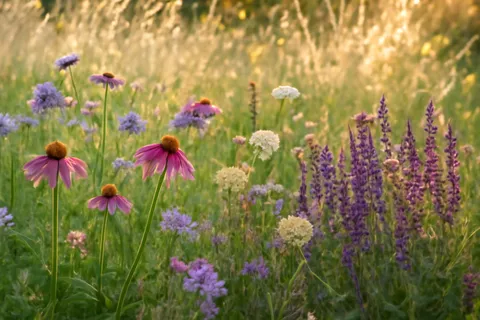
Dry summers — which are becoming more common across southern Europe and large parts of the US — expose the flaw in a garden designed around plants that need consistent moisture. A garden that looks good in June can look devastated by September if the plant selection is wrong.
The answer is not to restrict yourself to gravel and succulents. It is to choose plants that are adapted to summer drought, which is a larger and more varied category than most people assume.
What "climate-adapted" means in practice
Climate-adapted planting does not mean Mediterranean rockeries by default. It means selecting species whose natural habitat matches the conditions in your garden — not just the soil type and sun exposure, but the summer rainfall pattern (or absence of it) in your climate zone.
In a garden with dry summers:
- Mediterranean natives perform well — lavender, rosemary, cistus, salvia species, euphorbia. These tolerate drought and dry soil without wilting.
- Ornamental grasses are a strong structural element — stipa, pennisetum, and miscanthus look better in dry conditions than many conventional herbaceous plants.
- Drought-tolerant perennials — echinops, achillea, eryngium, and verbena bonariensis — deliver colour through summer without supplemental watering once established.
- Trees with deep root systems — oak, olive, carob — manage summer drought far better than shallow-rooted species like birch.
The establishment period
The one vulnerability of drought-tolerant plants is their first summer in the ground. Before a plant has developed a deep root system, it needs watering to establish — usually the first full growing season. After that, most drought-adapted species are self-sufficient in all but extreme conditions.
This is where an irrigation system pays for itself in a new garden: automated watering through the first summer allows drought-tolerant species to establish without hand-watering, and then they largely maintain themselves in subsequent years.
Mixing drought-tolerant and water-hungry species
A garden does not have to be all-or-nothing. Grouping plants by water need — a planting technique called hydrozoning — allows a mixed garden to include some water-hungry plants (roses near a shaded wall, hostas in a moist corner) while the majority of the border is drought-tolerant. The irrigation design follows the same logic.
A well-specified planting plan does this grouping for you, making the garden look intentional and allowing each plant to get what it needs without over-watering the whole border.
NeatSpaceCare designs gardens with climate-adapted plant selection as a core part of the brief. See the garden design service →