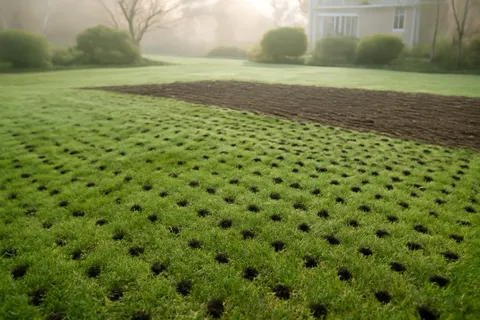
Most lawn problems that look like a fertiliser issue are actually a compaction issue. A lawn that is not responding to feeding, that pools water after rain, or that has a thatch layer more than 1 cm deep, is usually telling you the soil underneath needs air and drainage — not more feed.
What aeration does
Aeration — using a hollow-tine fork or a mechanical aerator to pull plugs of soil out of the lawn — relieves compaction, improves drainage, and allows fertiliser, water, and oxygen to reach the root zone. Without it, even a correct fertiliser programme sits largely on the surface.
When to aerate
The best time is when the grass is actively growing but the soil is not bone dry or waterlogged. In most of Europe and the US:
- Spring aeration: late March to April, before the main growing season.
- Autumn aeration: September to early October, when the grass is still growing but air temperatures are falling.
Avoid aerating in summer drought — the soil is too hard and the grass is already stressed. Avoid waterlogged winter conditions for similar reasons.
How to tell if your lawn needs it
- Water pools on the surface after rain and drains slowly.
- The lawn feels spongy underfoot — a sign of compacted thatch.
- Grass colour is uneven despite regular watering and feeding.
- A screwdriver pushed into the lawn meets hard resistance at a shallow depth.
After aeration
Overseed immediately after aerating — the holes are ideal seed contact points. Water the lawn well for the following two weeks. If you are on a fertiliser programme, the next application can follow within a few days of aeration.
Aeration once or twice a year, combined with overseeding at the right time, is the single treatment that most consistently improves lawn condition in a short time frame.
NeatSpaceCare offers lawn care programmes that include scheduled aeration, overseeding, and seasonal fertilisation. See the lawn care service →